
Image by Pavel Danilyuk on Pexels. (All photos and videos on Pexels can be downloaded and used for free).
Part 1 can be found here. Part 2 can be found here.
Panelists: Vida Cruz-Borja, Gabi Francisco, Carljoe Javier; Moderator: Kenneth Yu
Kyu: Let’s talk about works done with AI versus works done purely from human creation. What about hybrids? In other words, where does tech come in in the creative process of storytelling in a positive way? Research, perhaps?
Gabi: In a gathering of book club representatives and readers, when asked at what stage of the storytelling process we would be OK with AI being used, a few said they were open to it being used at the editing stage. But overwhelmingly (myself included), the reaction was negative: “Heck No!” to AI being used, from start to end (even research done through AI is prone to error / hallucinations).
If we look at a book purely as a product, why should I part with my hard earned money if very little effort was put into its creation, if it’s something I can do myself with a few taps of the keyboard?
(And also, if you need AI to check your grammar, then maybe you shouldn’t be a writer in the first place??)
Readers are romantics. We think of books as pieces of another’s soul, unfolding in sentences unique to the writer. And when we read it, a sacred bond is forged between author and reader.
Will we still feel this way a decade from now? Only time will tell. As always, the market will have its say.
Vida: 100%–do not use AI for research if you don’t know how to evaluate its purported sources in the first place!!!
But as for the actual writing, I give a very specific pass to this recent novel whose title I forget, where the author used AI to write certain lines of dialogue because that character was AI in the first place.
Gabi: Is this Tokyo Sympathy Tower by Rie Qudan? LOL Carljoe and I have both read it as well. That book got a lot of flak for that very tiny (and IMHO justifiable) use of AI.
Vida: Yes, I think that’s the one! I have yet to crack the book open, but I think that was a pretty novel idea.
Carljoe: My last book on Pop Culture and AI lifts interactions I had with my various chatbots and drops them into the book. I dropped screenshots into the book’s pages. I don’t think there are any issues or “hybrid” concerns when it’s part of the artistic project. I do think that people have issues when you make claims to have written a book and then it turns out you just prompted most of it out. So there’s a lot of nuance here.
Vida: Agree with that. I’d like to see a world where people are using AI in the way you described, but that world is not yet imminent.
Carljoe: I still go back to this being a very human problem. Especially humans who will try to pass off their work as theirs when it isn’t. And then when they get caught, they’ll say they were experimenting. I mean…. More in my answers below about experiments and literature. But this is a very human problem of people not wanting to do the work because the AI can. Which I can understand if you are just a person who wants some text to exist. But if you are claiming to be a writer, brod magsulat ka naman.
Vida: When I was advising a thesis class, I had a no-AI policy. A student asked me if it was okay to use Gen AI for coming up with ideas (this was back in 2023). I gave that a pass because some months before, I came to session zero of a D&D campaign empty-handed and asked ChatGPT to generate a certain character for me. I was mostly happy with what it gave me, and then I added my own flourishes many sessions later. So who was I to ban using it for idea generation in class?
But I think I’m going to revise my stance on that in 2026, with my hope of living a slower life in mind. I wouldn’t use it even to generate prompts for my ideas because my skills at picking up bits of interesting conversations, facts from books and videos, and generally talking to people for research will atrophy. I don’t want to offload the parts of the work that I generally enjoy and keep me sharp to AI. And if I were to teach a class again–and I probably will soon, in a very different context from a university–I would still ban AI use because the trend is to offload the “hard parts” of writing a thing to AI, but those very hard parts actually enrich the writing itself.
Carljoe: I teach an Emergent Literature class. Emergent lit is a kind of moving target, but specific to my approach I look at tech. I pioneered it last semester, teaching it again next year. And the basic question is, how do we use new technology, including but not limited to Generative AI, to explore the boundaries of artistic expression? I draw on the ideas of Dadaism and Conceptual Art (where unoriginality and decontextualization, as well as transgressive practices like plagiarism, can become part of the artistic process) as initial building blocks, and then I add on more contemporary ideas like Uncreative Writing.
So again I think it always goes back to artistic intention. What better way to dehumanize and defamiliarize your artistic production than to literally use an artificial intelligence as part of the process? Of course all of this falls under experimental and avant garde art, so it isn’t really the kind of stuff that you’ll usually find on bookshelves or typical gallery walls. Can we use AIs to prompt us into creating literature? What are the artistic boundaries that we could never explore before (data science as art?) because we didn’t have generative AI? And in terms of ownership, if the initial lines of your exquisite corpse were AI-generated, does that invalidate your authorship of the work? These are questions worth exploring and you can only explore them if you are engaging with the technology and seeing its limits as well as your own.
Moving beyond that which is specifically experimental, I would just reference the De Minimis AI Use for Authors declaration, which means that you can use AI for specific things but can still mark your work proudly human. I really think right now these are important dichotomies, but just as when I started teaching and we had students having to declare they used Google or Wikipedia and now it isn’t really anything, we will find what the appropriate things are. We are just in the messy period of the moment.
Gabi: It’s an issue of artistic integrity, muddied by market forces. Some humans want to publish a book but aren’t willing to put in several years’ worth of time to do so, so they use the AI shortcut. From a business perspective it makes sense, but from an ethical/artistic viewpoint, it’s anathema. Uploading your detailed plot points in a spreadsheet, then selecting your preference amongst several LLM’s phrasings, is quiltwork, not writing.
Vida: Okay, I’m sorry, but to be snarky for a moment, I don’t understand those people. They want to create a book quickly but they’re also the very same people who don’t want to read anything longer than a tweet? Make it make sense!
Gabi: I don’t understand them, too, Vida. LOL. Especially when they claim to be readers. It shows a lack of respect for the craft.
Kyu: Let’s try to play Madam Auring. This is a two-part question: How do you think AI will affect readers? Let’s take into account not only readers of today, but readers who will become AI-native? I’m now talking about the consumption of stories, not the creation.
Carljoe: Just gonna call out, “What an old old old reference and I hate that I know it.”
Kyu: Hahahahaha
Vida: Dammit Kyu, I said above that I can’t tell the future even with tarot cards! Haha!
Kyu: Try lang, Vida, haha! It’s part of the fun. It’s also part of a writer’s mind: It’s not only, “What if?”, it’s also, “What then?”
Vida: Fine, fine.
Kyu: Hehe.
Vida: A pessimistic view, but I’m following my own pattern. I realized recently that there are certain very old works of English literature that I would love to read on my own–but I can’t, not without the guidance of an expert in that specific literature who can contextualize what was going on at the time the literature was written that influenced everything down to word choice and references. Divina Comedia comes to mind, as does the works of Jane Austen, although I can still more or less keep up with the at-times dense prose. AI natives are also going to encounter the same problem I am encountering, so I’m going back to what Gabi said about teacher performance in the previous question and place part of my faith in the teachers of tomorrow to ignite the spark of interest.
The other part of my faith, I place in me. It occurs to me that my daughter will become one of these AI natives. It’s up to me and my husband to instill the foundational reading habits and general media literacy in her. When I was little, I had this big set of Little Golden Books that my ninang bought and kept for me in her house. She promised me that they would become fully mine to pass down to my own baby someday. She passed away long ago but that someday is now here, and I’m all fired up when I think about giving my baby even just a portion of the education I received outside the classroom. In fact, after this chat, I’m gonna go upstairs and read my favorite one, “The Twelve Dancing Princesses,” to her before bed. Hopefully she’s still awake!
Carljoe: I’m as usual going to shift the question. Because “fortune-telling” presumes that things are pre-destined and we are guessing at what they are. Part of my advocacy is getting people to realize that we have the power to decide how we want things to play out. We as educators, writers, readers, citizens, whatever identity you want to bring to the table, we can advocate, we can push for policies, we can build communities that actually stand for and fight for things.
So I don’t want to guess at what the future will be. But I want to suggest that people start imagining what they want the future to look like. Then ask, what are the interventions we need to start making today to get to that future.
We want people not to be so addicted to their phones? Then let’s advocate for platform accountability and government interventions so that platforms can’t design their products to be so addictive. We want kids to have better attention in schools? Then we are going to have to start making decisions about phones on campus and even appropriate device etiquette in class. Not only will we need rules, but if students violate this, will parents support and back teachers up in establishing device etiquette?
I was at a recent training where representatives from the Republic of Korea were talking about their approach to AI adoption, and they said it was “measured and thoughtful.” See that’s what I want. I want to see policies and say, “Huy, ang ganda, talagang pinag-isipan nila ito.” That means it’s AI deployments that help teachers be better at supporting students, help students learn better, and overall, enable us to go beyond what we currently often are. Imagine going beyond all the current panic of “Oh no, because of AI wala nang talent pipeline” to “Here is a chance, as the world reorients itself in the wake of new technologies, for us to figure out how we become more competitive.” Korea, Japan, Taiwan, didn’t become economic powerhouses overnight, but they accomplished things through thoughtful policy and disciplined execution. This might be that moment for us. I don’t predict that this is what will be, but I’m saying we could all align to move toward this, or other similar positively imagined futures.
Vida: I also read an article earlier today about how France’s justice system found the CEO and executives of Lafarge (a large cement company) guilty for aiding and abetting terrorist organizations in Syria. That made me hopeful that there will be more of these big lawsuits and policy changes that will–again, I hope–trickle down to our part of the world.
Gabi: It may be naive, wishful thinking on my part, but I’d like to think readers will yearn for the unique, for what stands out. In a sea of AI slop, the raw humanity of words wrought through struggle will shine through.
Also I take hope in how teenagers of every generation generally rebel against the establishment. So if LLM lit is the baseline, my hope is, the youth will be hipsters and gravitate towards non-LLM lit.
As a teacher I think our work is cut out for us: develop a taste for good old-fashioned storytelling in children. It starts by reading human-made stories to them in school, or at bedtime. Have children equate books with love this way. Teach them the thrill of being read aloud to, the musicality of language that actual humans can produce. Taste cultivated when very young tends to remain as preferences until adulthood.
Kyu: Let’s now talk about other forms of art and let’s see what similar effects AI may have on them that parallel what we have been discussing earlier. Some of these other art forms tell stories in their own ways (video, for example), but one could argue that paintings, music, sculpture, dance, they tell stories in their own ways, also.
Gabi: I think AI can’t ever substitute any art form done live. Locally someone tried to write a musical using AI last year, but the preview was universally proclaimed a disaster in print, so thank goodness for the establishment sending a strong message of discouragement, making an example out of it.
Certainly AI can churn out kitsch / film / music slop, but not the kind of art done live since this is human-to-human interaction, and since its origin is Greek theatre, it was practically a religious ritual, with primal feelings evoked utterly dependent on the spontaneity of the moment. A machine, no matter how intelligent, cannot respond to the exchange and flow of energy as only a fellow human can.
Carljoe: My own contentions here are that I also don’t think substitution is the frame. It’s definitely not what I want. But I do want us to explore what kind of artistry can be expressed or enabled by AI. Further… I actually think that kitsch has already found its way into certain kinds of artistic expression. The kitsch/art thing is, as are many parts of our conversation, elitist. I enjoy certain forms of kitsch and find that there is artistic merit. Perhaps that’s for another conversation, but we are constantly changing what is art, what our definitions of art are. That’s actually very exciting to me.
Gabi: I’m reminded of the seminal article “Avant-garde and Kitsch” by Clement Greenberg, where he differentiates between two seemingly similar artifacts. By his definition, anything produced by AI isn’t art, and is merely kitsch (mass-produced, cheap imitations). The US Supreme Court also does not consider AI generated output as art, as only human-made creations can be under copyright. So we are seeing a history of discernment between what passes for inferior art, and true art.
Via: May I present to you this glorious screenshot of a Variety headline:
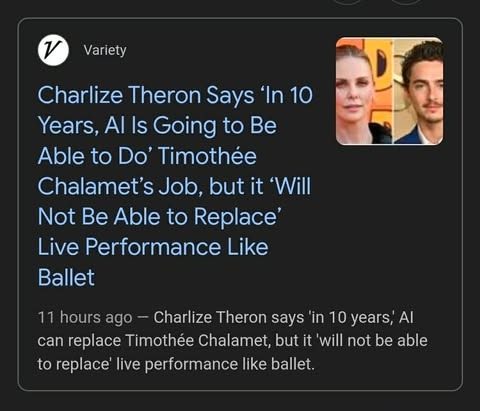
I would love to see a boost in live performances! I just don’t know how literature is going to evolve to cope, apart from spoken word. (As an aside, one of the other art forms I practice is crochet and AI has wreaked havoc there too, in that there’s been an influx of patterns that don’t make any sense.) At the same time, I don’t think I’m the person to figure out how it’s gonna evolve; I’m gonna leave that up to the future craftspeople.
Something Gabi said above reminded me of the other great force that is fueling the big changes in our world today: the loneliness epidemic. We treat each other so shittily because we as a people have grown disconnected from our own emotions and each other. Maybe it’s naive to say, but maybe connecting with each other over live performances is part of the cure.
Carljoe: I’m going to take a more controversial position here and say I won’t close the door on the possibility of people using AI as the primary tool for artistic creation. I just don’t know what that would look like yet. But I think given the possibilities of AI (and not just generative AI) and the right kind of artistic mind set to it, we might be looking at some arty forms that we as yet cannot imagine. If you replace your word processor or your paintbrush with AI tools, what could you come up with? Again, that’s one of the things I explore in one of my classes.
So I want to say, looking at where we are now and with how people are using this stuff now, it’s hard to imagine. But I honestly, believe, with the right imagination and artistic mind, someone is going to come up with something and it’ll be great and then suddenly the whole, “Can you make art using AI?” question will be dead. Then AI just becomes an option among the many tools a creative person can use to express themselves.
My really silly example at the moment is that I have a Smart amp I use for guitar practice. I tell it the kind of guitar tone I want, and it suggests amp and effects configurations. Then I start playing and it detects my tempo and chord progression, and it generates drums and bass as my backing band. I choose which groove I want, then I start playing with this auto-generated band. I am able to express myself without any feeling that this AI is taking away my creativity, or that I am less of a human because I used AI to help me with my art.
Now take this one example and think, if for other mediums, art forms, etc, people figure out uses like this for self-expression, then it would seem inevitable that we would get more art thanks to this.
Gabi: But would you say, Carljoe, that jamming with your Smart amp is equal to the experience of jamming with live fellow musicians?
Carljoe: No, it’s different. But that’s kind of the point. Jamming by yourself or with certain limitations can be the constraint that leads to something. And jamming with others is another.
An example: when I did a recording session, I really struggled because there were no amps in the room. It was all digital, with amp emulations into a computer. It felt “wrong” to me. It felt…unnatural. But also, that’s how a lot of people record these days. And in fact, that kind of recording opens up a lot of opportunities for better recording and post-production.
So I guess I go back to this idea of it’s not an either-or/AI-or-not, but rather that we can start to see these different ways or new forms of expression. Technology provides new opportunities.
Kyu: This concludes our written panel on “Humanity in Stories”, and I’d like to thank Vida, Gabi, and Carljoe for the deep and in-depth discussion we had. Even the hours we spent typing away at our computers was not enough to take in and discuss all that we could have brought up. A live panel held on a stage with attendees normally lasts an hour with a Q&A afterwards; the four of us took four hours together online writing our thoughts down and digesting what we each had to say. I think that we got more ideas and thoughts down this way than we would have in a live panel. But reading through what has been posted, I’m sure you can all see the many tangents and directions these various points that have been made could still take, especially for an encompassing bit of tech like AI.
We invite everyone to read, re-read, and share what we have posted here on Philippine Genre Stories, to give it your own deep thought and consideration, and to take the discussion further in those different tangents because we want this written panel to stimulate conversation and, where applicable, elicit actions and choices driven by ethical conviction. Perhaps there will be others among you who would also like to instigate and then share your own written panels on this topic so that the discussion can advance further. At the very least, we hope that what we have posted will give you thoughts to ponder upon while we are in the middle of this technological transition.
Thank you once again to Vida, Gabi, and especially to Carljoe, whose idea it was to have this written panel. Not only was the activity interesting, it was great to spend this novel digital time with friends and fellow book-lovers talking about a topic that is sure to affect reading, writing, and stories. The fact that you all took hours of your time away from your friends and families to do this is not unappreciated. Thank you!