
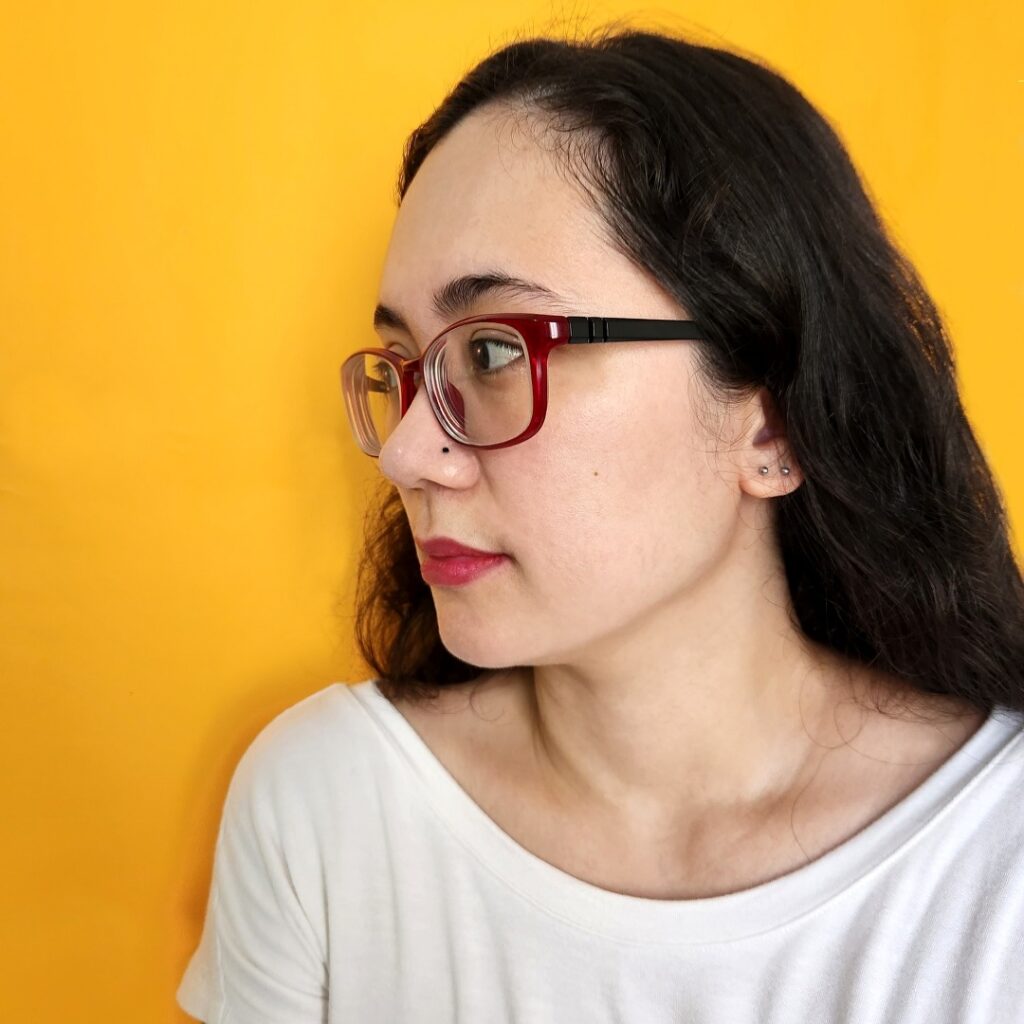
Michellan Sarile-Alagao is an editor, educator, writer, wife, and mother. Her work has been published in various print and online anthologies and magazines, and she has written several children’s books that focus on mental health and children’s rights. She was a poetry fellow at the international Roots. Wounds. Words Annual Writers’ Retreat for BIPOC writers in 2023, the 45th Silliman University National Writers Workshop, and the 6th IYAS La Salle National Writers Workshop. She has a BSc. in Criminology and Psychology from the London Metropolitan University and an MFA in Creative Writing from DLSU-Manila. She is a Board Member for the Christian Writers Fellowship and one of the founding members of the Philippine Speculative Fiction Society. She is a program director at Abot Tala, a self-directed learning community. You can find her on Facebook and Instagram @michalagao.
Your body of work spans poetry, children’s literature, and genre fiction. How do you personally define the difference between the literary and the popular in writing—and where do you see your own works sitting along that spectrum?
The short answer: I think the difference is made up and the spectrum is circular, like the color spectrum, so my work is on different points of that circle, sometimes mixing, sometimes complementary. I hope that makes sense, haha!
The slightly longer answer is that who and what defines what is literary and/or popular changes throughout time. One of my writing group buddies shared this article about the term and why it doesn’t work anymore and I mostly agree. I think we can all agree that the popular (or genre) can be literary and vice versa, and that labels are limiting (the limit does not exist!) and used primarily (?) for marketing – which isn’t necessarily a bad thing, but it’s not the thing that’s top of mind for me during the writing process.
The idea of ghosts taking away painful memories is deeply affecting. What inspired this concept, and how does it connect to your recurring themes of mental health and healing?
The idea for “San Quebrado” comes from a personal, unresolved space. In 2018, I cut off direct contact from my father to protect my mental health. We never saw or spoke to each other again; he died about a year and a half later. I was very angry at him, for a very long time, and I was angry at myself, too. Eventually the anger (most of it, anyway) passed, and I wanted to write a story for/about him but didn’t really know where to begin. During the pandemic I listened to Springsteen on Broadway (The Boss was one of my father’s favorite artists), and in the introduction to “Long Time Comin’” he narrates a healing conversation he had with his father, right before he became a father himself. Springsteen said, “We are ghosts or we are ancestors in our children’s lives.”
It hit me that I would never have a conversation like that with my own father. My father was, and always will be, a ghost. So I started writing some things with that quote at the back of my head, and one of the things I wrote was a story about ghosts, memories, and healing, and how I wished that ghosts could heal instead of haunt. That story developed into “San Quebrado.”
As a founder of the Philippine Speculative Fiction Society, how has being part of—and helping build—a writing community shaped your growth as a writer?
I recently (and half-jokingly) told some writer friends that it helps with my impostor syndrome, haha! Community building can be a positive way of dealing with impostor syndrome because whenever I feel like I am a terrible writer, I think to myself, “I’m just going to hang out with other writers and help empower younger, better writers so at least I’m not a complete failure” (iyak-tawa).
On a more serious note, being part of a writing community has helped me regain my enthusiasm for writing again and has encouraged me to take more chances with my writing. I’m grateful for all the writing and reading communities that I’m part of, especially the Philippine Speculative Fiction Society, where I’ve met some hilarious, passionate, generous, and talented writers, readers, and creators.
For emerging Filipino writers who may not yet have access to literary circles, what advice would you give about finding—or even creating—their own writing community?
Unfortunately, you will need to talk to people (awkward laugh). I think for a lot of writers, it’s hard to transition from the writing cave to the outside world, so I suggest you start small. If you have just one friend who also writes and wants to hang out once in a while, then that’s already a start. You can meet up (online or IRL) and read together, do a writing sprint, and show each other some work for feedback. Then you can add another friend if you feel like it, and another. Your group is your community, and it can be as small or as big as you all want it to be.
If you’re looking for an existing community to join, ask yourself what kind of community you’re looking for: Do you want to meet people who enjoy the same/similar genres that you write or like to read? Do you want to meet writers that share the same beliefs/values or are similar to you in some way? You can find people and groups online, or in events like book launches and writing workshops. Sometimes you meet people/groups you click with, sometimes you don’t. Also, cheesy as it sounds, be what you want to see. If you want feedback on your work, give feedback when others ask. Exchange tips, read each other’s work, cheer each other on, and don’t take everything personally.
What’s the one thing not mentioned in your profile that you would like people to know about you?
I love watching K-Dramas. Some of my faves are Alchemy of Souls, Beyond Evil, Chicago Typewriter, Goblin, Itaewon Class, Marry My Husband, My Mister, Reply 1988, Signal, and Welcome to Waikiki. I’m open to recos, any genre!