
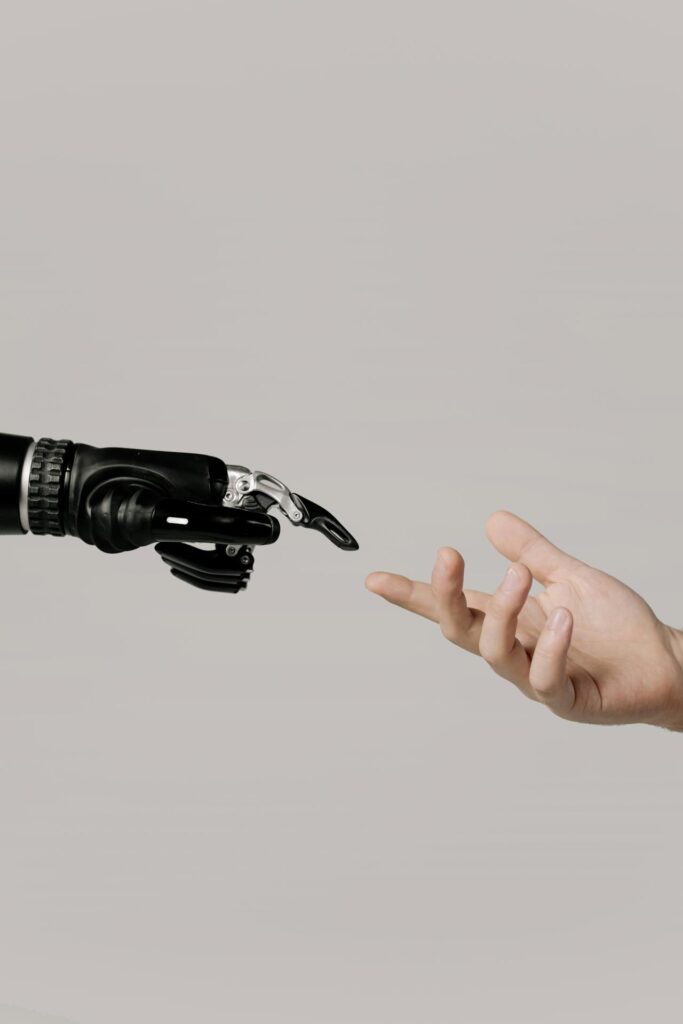
Image by cottonbro studio on Pexels. (All photos and videos on Pexels can be downloaded and used for free).
Panelists: Vida Cruz-Borja, Gabi Francisco, Carljoe Javier; Moderator: Kenneth Yu
AI is a man-made tool. Like all tools, it can be used the right way and the wrong way. A hammer can be used to build furniture or to destroy property; a knife can be used to cook and prepare food or to stab someone. Like any tool, AI in the right place and with the right intent can help make human lives easier. The four of us got together to discuss this issue as readers, writers, editors, publishers, educators, and ethicists, because we are seeing this tool being misused from our respective and varied points of view.
Midway through this written online panel, we realized there was no way to cover everything we wanted to discuss. The tangents were just too numerous, veering in all directions, because AI is one tool that could affect the majority of the aspects of human life. We hope that this written panel would instigate insightful and thoughtful discussion among its readers because–believe us–if the trajectory of AI continues, there may be no way to avoid it in the future anymore.
Kyu: From the very title of this panel, “Humanity in Stories”, which we are discussing in this burgeoning age of AI, why do you think we need to discuss this? It sounds…basic, as storytelling is reflective of our shared humanity (the good parts and the not so good about being human). Stories by nature, like all art, cuts through to what humans are thinking of and contemplating on, after all, a way to express who we are or who we could be.
Carljoe: YOOOOOOOOO
So what are you all up to on a Friday night and why is it not something cooler than typing into a Gdoc?
Gabi: Because you asked awwwwwww
Kyu: Hahahaha
Vida: I would rather be talking shop like this than do one more minute of edits!
Kyu: Hahahaha
Vida: To answer the question, I think the way we tell stories has changed so fast in these last couple of years. I definitely remember complaining about a completely different set of problems I’d see in the work of newer writers ten years ago, most of it to do with stories being carbon copies of the big-hit US fantasy novels of the day without bringing their own flair to the page. And now there’s a new set of problems, but they’re consistent—persistent, even, and I feel like we have to think of solutions on our feet. Why is that important? Because, on a macro level, a bird’s eye level, stories can change the entire trajectory of nations and I’m really concerned about what I perceive as a sort of carelessness with the way people tell stories nowadays. And it seems to me that the humanity is bleeding out of the stories I see being told and propagated today.
Gabi: It sounds alarmist but I think the very meaning of what it is to be human is at stake. Language and meaning change when societies agree upon a different interpretation. With the onslaught of LLM’s and generative AI (with zero to little guard rails), the next generation is growing up with very different ideas on creativity and artistic integrity.
Kyu: You both make it sound like today’s world is going to remove our humanity…that’s a big warning…care to expound?
Gabi: Not remove but definitely alter. I am thinking of the definition of “art.” Some might say that their AI generated art qualifies as such. As if a few minutes of prompting were equivalent to years of training and intense artistic labor.
Carljoe: I am inclined to acknowledge that generative AI is a factor that is triggering a lot of issues with writing. However I would argue that, while it is incredibly powerful as a technology, one perspective to take is that it’s only piercing an already weakened armor. We have educational systems that have constantly deprioritized humanities education and this has limited our imaginations as a society. We’ve prioritized religions, however problematic and cultish, over ethics and civics education. When we look at the problems in writing, these are offshoots of larger issues in a society that, when it can, devalues art and artistic production. Our society wants automatons.
Kyu: Special clarificatory question: Are you guys talking about the Philippines? Locally? Or do you have an international or worldwide sense of this as well?
Gabi: I’m thinking of Filipino students and authors in particular, especially those I come into contact with as an educator, and as a booklover who haunts local bookish events and reads as much contemporary Filipino lit as possible.
Vida: I am speaking of stories both from the Philippines and beyond our borders. I’m a full-time freelance book editor (have been since 2020) and I’ve taken on both local and international clients. I also taught Creative Writing at Ateneo for a full school year (AY 2023-2024), and I used to be a Submissions Editor for Uncanny Magazine from 2014 to 2017.
Carljoe: I’m approaching this as a Filipino. I think that while I might be plugged in intellectually to international perspectives, the value (I want to imagine) I bring is from speaking from my specific contexts as a teacher, creative person, journalist, etc struggling in the Philippines.
Kyu: Let’s set context from the first question: where are we coming from (from your own individual perspectives and experiences) that is giving you new insights and thoughts about humans and how they tell stories today versus before? What do you think is evolving/changing?
Gabi: I’m a teacher who teaches kids how to read, then teaches them to understand and write their own stories, then helps them tell stories through theatre. This new generation of students are not only dealing with a lack of social skills, but also think nothing of using LLM’s and AI for creative work submitted as school requirements. They know so much in terms of knowledge, yet have to be taught the ethical, moral reaction to current events. The human teacher is no longer dealing with tabula rasa, but a blackboard already filled up with the whole internet: the good and the bad.
Carljoe:So basically all knowledge at their fingertips but no wisdom/insight/discernment.
Kyu: Carl read my mind. I was going to ask, “Is it an ethics thing? Is it a case of teaching kids that they have to respect where the knowledge came from? To paraphrase the old Dungeons and Dragons quote: wisdom isn’t intelligence, and vice versa.
Gabi: Even the moral response has to be taught. For example, when they bring up Epstein as a joke, or the war in Gaza as a subject of fun, the adult in the room has to model outrage or sorrow and explain why it’s inappropriate to treat them as internet memes (which is usually how they’re exposed to these unsavory topics).
Vida: I really feel this. I had a baby a few months ago and I am constantly thinking about how to educate her—specifically, how to impart the kind of media literacy education I received. If we lived in a different world, she would absolutely be a low-media child. But that’s unrealistic given her mother’s career path hahaha. So I’m thinking our attack should be in the direction of how we talk to her, how we impart empathy and whyas well as how, she should behave toward others, and how she can navigate social situations. And there’s the issue of bilinguality as well! Among my students in Ateneo and even in my own generation, I noticed how parents don’t want to teach their kids Tagalog, so you have these Filipino kids reaching undergraduate thesis age without knowing how to at least speak Tagalog well, and yet wanting to write about the Filipino experience. If we don’t give them the tools in both languages, how will they be able to discern the information they’re receiving every day on the internet and properly use that information when they make their own art?
Gabi: That’s exactly it! More than ever, I think kids need to talk to (and learn from) HUMANS, to process the info they get from the machines. And that’s why I’m scared of the LLM/AI in education movements recently. Like AI education providers, for example. The powers that be embrace it prematurely, I think. When I asked the providers at what age he thought it would be fine for kids to use their AI to learn, he said, “The younger the better.” As a teacher, I was appalled. It’s all about selling the product, not about what’s best for the child.
Kyu: As a Gen Xer, I can tell you that this wanting to speak only English instead of Tagalog has been around for years…it was prevalent even back then, decades ago.
Vida: Oh, I know. I confess to being only a competent Tagalog speaker. My reading and writing skills in that language are wanting, but not for lack of trying! I was just raised with English only.
Kyu: The fact that the powers-that-be embraced it prematurely may also show that they, too, have a weak grasp of what the humanities can teach, right?
Gabi: I suspect they embraced the path of least resistance. It cuts down on the need to have well-trained teachers. For decades, teacher education has been going down the drain. And now, the new generation of teachers no longer write lesson plans or assessments: they just use LLM’s to create them. And even to check student output. They claim it will cut down on teacher work load, which is true, but at what cost? I’m all for using new tools and technology to bring students into the 21st century, but I am not OK with removing the human element in education in crucial ways. If a teacher uses an LLM to create a lesson, makes learning materials with AI, then grades student work using AI… did she actually teach in any way that mattered?
True story: we had teacher applicants who, when asked a basic job interview question like “Why do you want to teach?,” had to type it in their LLM to read out an answer (and asked us to wait while the LLM churned out a response).
I think this true anecdote shows how bad things are, and makes me scared for generations growing up with zero critical thinking skills if they become slaves to LLM’s.
Carljoe: I wonder what it is about AI that makes people really want to give up their thinking and their agency. I mean, for a long time we had people saying GMG, which meant “Google mo, Gago”, which was to fix your ignorance by using the internet. Now here we are and I will acknowledge there’s something different happening here. Definitely something in the product design of AI. And what makes me sad is that this could be a really empowering technology and people aren’t using it that way.
My main reaction to this is that it’s hype, and too often we find people buying into this hype for fear of being left behind. FOMO is powerful. And when you see the larger targets and people saying “Look at these other countries…” then officials feel pressure and they push that pressure down.
But also, the real problems are class size, lack of resources, lack of teachers, digital divide, etc. Connecting to my earlier point, AI isn’t causing this problem so much as it is exacerbating or revealing existing systemic issues. LOL I had planned to write about writing but now I’m on my education soapbox.
Kyu: Please expound a bit about what you mean by “weakened armor”. How strong was it before vs. why it got weakened to its current state.
Carljoe: At the risk of sounding like an old man yelling at clouds, which I suppose I am anyway, if you look at curricula now, there’s so much less humanities like literature Just recently DepEd cut its Senior High School programs, removing subjects like literature and media literacy or making them optional. CHED is matching these efforts by trying to lessen years spent in college by removing humanities subjects. (Moderator’s note: Philippine education authorities are in the news for this lowering of the number of General Education units in the curricula, which is where the humanities are). The logic when we shifted to K-12 was we needed to because kids were graduating but were not ready and educated enough to enter the workforce. So we expanded to K-12. Now because education is expensive and we need people to enter the workforce sooner, we are cutting, and we are cutting humanities subjects. This communicates that humanities are less important. That’s what I mean. So when you have something like generative AI which can do a lot of stuff that overlaps with knowledge work, then you can see the impulse to then target humanities-driven work.
Of course on the other end of this, what will actually be more valuable and make people important is creativity, the humanities, the ability to connect, and to understand. So all the human stuff. That’s why for me it’s not an “AI/no-AI fight”; it’s a, “What kind of society do we want to exist in and what kinds of investments are we making toward that?”. And so AI becomes a bogeyman and distraction against larger concerns.
Kyu: Is there anything you see different from editing and reading as an editor comparing back then to today?
Vida: So before, especially among young Filipino writers, all we had to deal with was decolonizing our perspectives and mentalities in our writing. That includes favoring white characters in western settings and giving them ways of solving problems that would absolutely not fly in our culture. I’ve written a whole essay about this last one in particular. All we had to do was grapple with our “Filipinoness” and what constituted being Filipino anyway (spoiler alert: by virtue of being Filipino, what you write is already Filipino).
Now, I’ve also seen the rise of what has been called “TV brain writing.” This happens when the writer unthinkingly transcribes what is occurring in a video playing in their mind. So you’ve got a decidedly noticeable lack of interiority in the story, which becomes a mere collection of actions and dialogue, and occasional descriptions that don’t do much except bog down the narrative’s pace. Don’t get me wrong, I’ve borrowed certain techniques from visual mediums before—and everyone is free to do that—but the lack of interiority is startling because we don’t get to pause the narrative. We don’t get to dwell on a character’s hopes, dreams, fears, etc. Which is a shame because that’s a huge part of what makes us all human and what makes a reader feel “seen” when they read a good book.
I remember lecturing to my thesis advisees about this, about pausing the narrative and dwelling on all that interiority. The conclusion they came to is that they don’t do enough of that in their own lives (yikes), so it also translates into their fiction. (In short, maybe we all need a little therapy.)
Carljoe: Okay so here’s what I wanted to say in terms of storytelling. One of the things I’m seeing is that since I started writing up to now, there has been a proliferation of mediums, platforms, etc. Which is kind of awesome. However the unfortunate thing is there has also been a flattening of culture as a result of this. If you watched the last Oscars, this shows up in two ways, which are the bits where Conan does that Casablanca skit where he has to explain everything constantly because people aren’t paying attention. The second is the bit about turning classic films into vertical. And you know what’s crazy? People are more than happy to take in amazing things on their phones!? Even to the point where you also have YouTube recaps and then people will claim they’ve seen something because they saw the recap??? I can’t.
Okay so what does this mean for me? It means that there is a lack of discernment/understanding of how specific mediums work. Because culture is flattened by tech in the interest of “less friction”, people watch film and TV, read, etc all on their phone. But each of these artistic mediums demand different kinds of attention and engagement.
More importantly, each of these mediums has limitations and opportunities. So if you have film, you have sound and edits, which you wouldn’t have if you were making a comic book. And people’s ability to discern the beauty of those limitations means they will be appreciated less. And aspiring storytellers/creators who aren’t willing to learn because “all content is content” will fail to be good at a specific medium because they don’t know how it works.
Kyu: What do you think we are at risk of losing that is essential to humanity in stories from all that you have said?
Gabi: To be human is to struggle, to work out in fear and trembling our own independent choices, artistic and moral. With premature AI use in education and artistic creation, we not only see the homogenization of thought (everyone uses the same language patterns, everyone sounds alike and thinks alike, which has implications on raising a generation that wishes only to be part of a herd), but we also raise students who shy away from any kind of mental struggle. They don’t want to think. And when real life hits hard, my fear is that we are rearing an overly risk-averse generation who will melt at the first inevitable instance of friction.
Or in the case of authors who use LLM’s to “write” novels, it becomes purely output-based and disregards artistic integrity in favor of efficiency.
Carljoe: I just wanted to echo this bit here about what Gabi said regarding homogenization. And maybe that’s also a thing I worry about. People would prefer to have boring content, or to be overwhelmed with slop, than to not have content. I think that’s a problem. But also, this speaks to taste, or lack thereof. Like I’ve talked to students who were afraid to express opinions about culture because they didn’t want to go against “what the internet says.” At that point you don’t need censorship, because people will self-censor. And I’m not going to be one of those old guys who is against canceling. Some people and behaviors deserve to be canceled. But we also need to make space for alternative viewpoints to be engaged with. Instead, what happens is those with alternatives go down rabbit holes and get radicalized. So the way that conversations and thinking happen is part of the problem for sure. And in the classroom, if you are made fun of if you give wrong answers, or are only obsessed with your grade so you only want to give right answers, then you won’t take risks and I guess you’ll ask your chatbot for the answer. That brings us back to incentive structures in education.
Hmmm, okay, so one of the old school definitions of art I always think of is “it’s the chaos of life but you are imposing form upon it”. And that form is the artistic medium and its conventions. The way we tell stories is how we think, process, engage, and advance. So if we are just flattening everything, then we aren’t tapping into these different artistic constraints that allow us to be creative, that’s one. Pile on the problem of people doing things for the algo and you bring out the worst in people, because the more inflammatory and awful, the more it feeds the algo. So here we are. I’m not saying people weren’t vapid, or everyone was an intellectual before, but we are at a point where even if you have nothing to say, if you say it in an inflammatory way you will be rewarded by the algo. That’s a fundamental shift in expression, engagement, discourse, and more.
Vida: What do we risk losing? In one word: empathy. What happens in TV brain writing is all surface-level stuff. This also translates to how we interact with each other in reality. If all we process is the surface-level stuff, which is just one layer of information, how can we give each other a little grace, a little good faith? And how can we decide how to act accordingly if all we see is one layer of information?
Elaine Castillo has a great book of essays called How to Read Now: Essays that I think is better at fully articulating how reading can bias you toward and away from empathy. I think the one we’re looking for is “Reading Teaches Us Empathy, and Other Fictions.”
Gabi: Adding this to the TBR. Carljoe gave me William Gibson’s Neuromancer as a reading assignment LOL. Noting down my homework dutifully, po.
Kyu: So far, the perspective is that what is happening is, to echo Ted Chiang, “dehumanizing” stories and reducing “intention”. Do you guys think this cuts across cultures? Do all cultures react the same way to storytelling from modern stimuli? Or are the reactions and changes also culturally-centric, and that our perspective is from the Filipino culture?
Vida: Both. I think it does cut across cultures—we have been made a global and kinda monoculture due to the internet—but we also have culturally-specific ways of reacting to storytelling from modern stimuli.
As an example of the first, I think there’s a certain similarity, for instance, in how influencers—well, influence—across all cultures due to proven methods of getting attention on the internet. I think influencing can be boiled down to telling a story about a certain object, concept, person, or even story. I also think about how the internet gave certain generations from millennials onward a shared language of slang that cuts across cultures. And finally, I think about how disinformation spreads the same way in every culture nowadays.
At the same time, we have our own situations wherever we’re located in reality. To return to my inactive protagonist essay, I’ve noticed that it resonates in big ways with people with marginalized identities: women, disabled people, queer, and everyone who isn’t white. That’s because we’ve all lived inside systems where having a sword and a Big Damn Hero moment won’t solve the problems we face on a daily basis. But the reaction white people have to it is split down the middle: either they’re stopped in their tracks because they’ve never thought about storytelling in that light before, or there is huge pushback in the form of dismissing stories with inactive protagonists as “boring” or worse, flawed from a craft perspective.
Gabi: I’m thinking of layers of interpretation, that the basics cut across cultures (reflecting on plays / shows I’ve seen performed in languages I did not speak, but somehow understood because of body language and facial expressions). Native speakers would understand deeper levels. But yeah, the internet and globalization has flattened the world considerably even before AI and LLM’s. Basically any Filipino who is connected will have a certain understanding of internet culture (predominantly Western / American).
Carljoe: I’m thinking of the “influencer voice” where again, there’s this flattening or homogenizing. I’ll blame the algorithms, and then chatbots push everything to the middle. That’s the thing though. You could take people who are below standard and empower them with AI to get to middle or higher performance. But instead, people are just using AI to flood the world with sameness and boring stuff.
But also…maybe people are happy taking in mediocre slop? That brings us back to the lack of training in media literacy, literature, art appreciation, etc. I mean sorry if that sounds elitist. I’ve been accused of that before. The sameness and sort of “culture-as-candy” approach is something I can understand, but if you only have candy, I mean, at some point it won’t be appealing to consume the same-tasting items over and over again. A variety would widen the palate. . But is this where this kind of culture is taking us?
Gabi: I’ve seen this homogenization of thought in action, when students handwrote essays in front of me (so I know they’re not using LLM’s), and their essays had a lot of phrasings and patterns commonly used in AI slop.
This ends Part 1. Parts 2 and 3 will be posted in the coming weeks.