
by Kenneth Yu
A few weeks ago, a friend, Carljoe Javier, messaged me. Carljoe is a writer and creative but also an AI ethicist who is deep into the latest technological advances in AI, especially concerned with how AI is affecting not just the creative field, but society in general.
He told me that there were two social media posts by mutual friends about AI that garnered his attention precisely because they, too, echoed somewhat his own concerns about the direction we are all being taken in. These posts were by mutual friends Vida Cruz-Borja, a writer and editor; and Gabi Francisco, an educator, book reviewer, and theater lover.
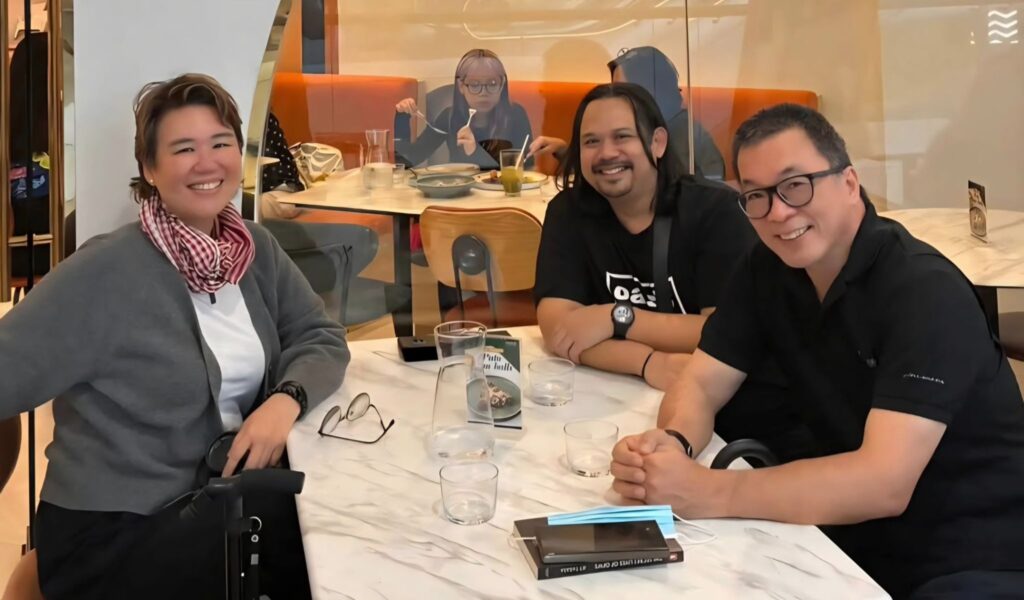
From left to right: Horror writer Yvette Tan, Carljoe Javier, and me, having coffee one afternoon sometime last year.
Carljoe told me he wanted to get together to talk about AI and tech and how it’s affecting our storytelling as human beings. In particular, he, like Vida and Gabi, had points to raise about how, upon being prompted, LLMs homogenize not just information, but actual fiction after bots have gathered and crawled through the works of human storytellers. Together, he wanted to explore possible effects and gather all our concerns from our different viewpoints.
The appropriateness is not lost on me that Carljoe did not want to get together and do a physical panel, or even a virtual panel, record it, and then upload it. No, he specifically sent me a peg wherein the panelists typed their answers down, sometimes simultaneously, to questions posed by the moderator, and then all would interact at their own time and in response to each other.
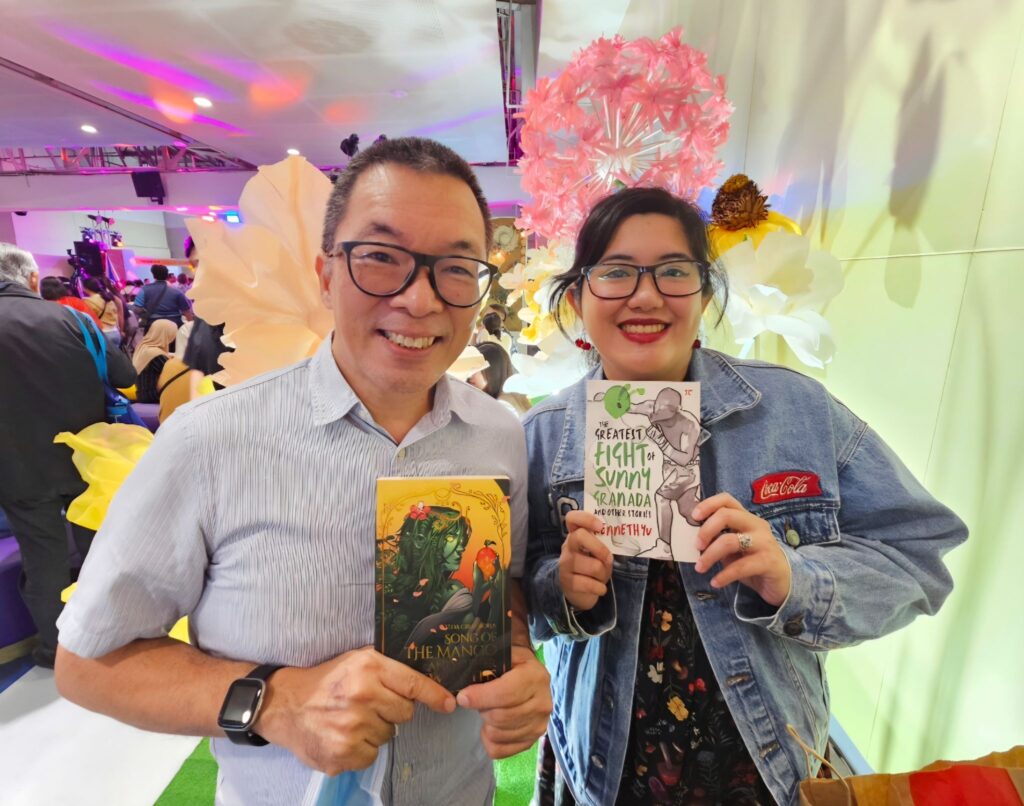
Me and Vida Cruz-Borja, author of National Book Awardee “Song of the Mango and Other New Myths”, published by Ateneo University Press in 2022 and which I’m holding up.
And so, that’s what we did. We got together on an online document where Carljoe, Vida, and Gabi were the panelists answering my questions on our chosen topic, actually typing, without any form of video or aural communication. All we had was a separate chat group for support.
It made for a bit of a messy approach–messy in a good way, mind you–and it also gave more time for everyone to answer or come up with their own questions. We needed two two-hour sessions to finish the panel, which shows just how much we were engaged in this written discussion.
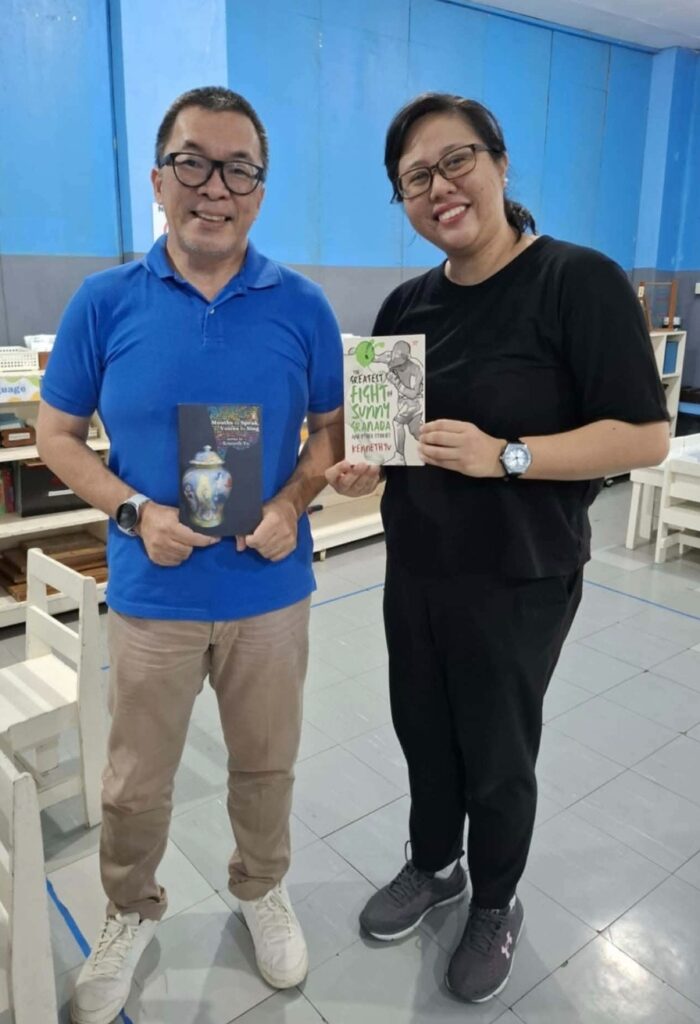
Me and Gabi Francisco, educator at Regina Maria Montessori and book reviewer at Ex Libris Philippines
And that’s the hub: this isn’t a video or even a podcast. We, as a group, want you to read what we discussed as if it were a transcript so that this will engage your reading faculties. Not through video as if it were on a screen. Not through listening as if it were a podcast, but through actual reading.
And we guarantee none of what will be uploaded was AI-assisted. It helped that all four of us were fairly fast touch-typists.
We hope that, after this is edited properly and when we upload it, it will not only be coherent (we humbly request you for some slack because having a “written panel discussion” was something new to all of us), but that you will find our thoughts engaging and worth the reading as well, and that it also stimulates your own thoughts and opinions on how technology is shaping how we tell and consume the stories that make us human.
The bios of the panelists will be posted here on Philippine Genre Stories before April 2026 ends, and then watch out for the multi-part “written panel discussion” on “Humanity in Stories” to be uploaded also here on Philippine Genre Stories sometime within May!