
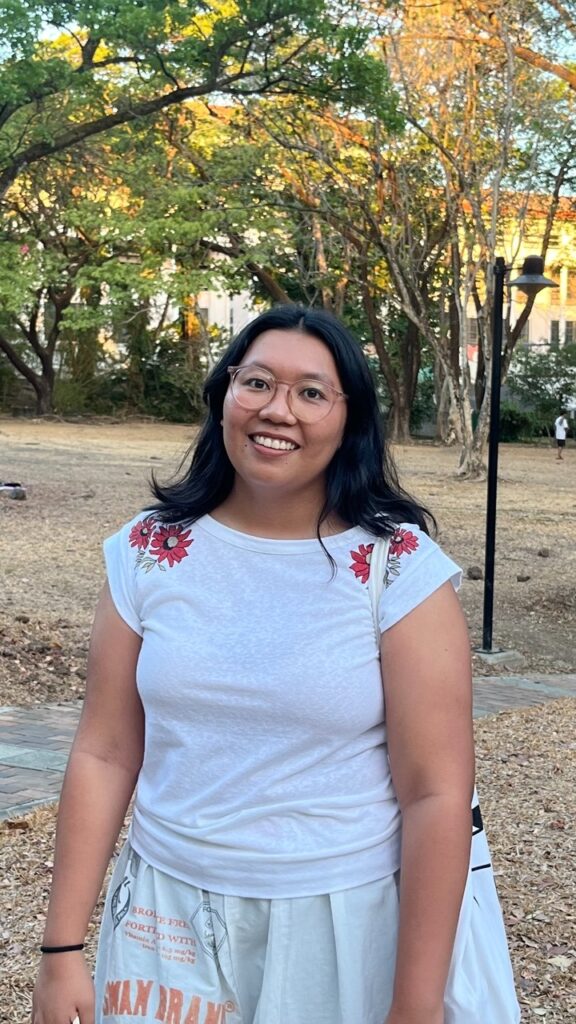
Ysabelle C. Bartolome teaches at the University of the Philippines Diliman. She likes reading women in translation and manga.
Where did the story idea for “The Day the Fire Cat Appeared in Purok Laon” come from?
I first wrote a version of this story for my undergraduate class. At the time, the Manila Central Post Office caught fire and like every Filipino netizen, I was anxious and skeptical of the whole situation. The fire reminded me of my experience in this one urban poor community in Quezon City. There’s a section in this community that burned down to the ground even though the whole neighborhood is located right next to a fire department. One of the women told us that these fires often start in their neighborhood. Someone would set stray animals on fire to expedite their relocation. After learning this, I always feel troubled when I hear news of fire. I figured why not write about this.
Why did you choose the magic realist mode to create a story based on notes you had written as a student volunteer in an urban poor community?
I feel a closeness with the magic realist stories of Latin America. I think they capture the life of and in a community well. Whenever I read them, I feel like they are also describing my neighborhood and my life. At the same time, this narrative mode is able to carry ambiguity and narratives of political violence. These factors were helpful to me as I write from my notes which have a lot of gaps.
From the beginning, I wanted this story to be about the community, not just a certain character or the magical elements. A big reason why I wrote the story in this mode is because the community I went to became a mystery to me. With the pandemic, I wasn’t able to go back or get news on their situation. Today, the whole sitio does not exist anymore and it’s replaced by a hotel casino. The state of Purok Laon at the end of my story captures how I feel about what happened in real life.
Also, I didn’t have the heart to depict animal cruelty so I turned them into magical creatures.
When a society is fractured by systemic inequality and censorship, can fiction act as a legitimate tool for structural change, or does it merely serve as a temporary emotional pressure valve for the privileged? What can stories actually achieve?
This is a very difficult question. If stories have power, ultimately, it can only be achieved if people read it and we have a literacy crisis in this country. This is a problem that all Filipino writers contend with.
I also cannot deny my privileged position as the writer of this story, the outsider who wrote about a visit they had with the urban poor community. But this is valuable learning, you need to study the political situation and the social conditions of your country. The challenge is how to write justly.
For this story specifically, I see writing as a way to document histories and lives especially because systemic inequality erases or downplays traces of the daily violence that we experience. Stories are always part of a community, whether oral or written. They tell us that life was once like this, people felt and thought this way, this is how others survived, and these seemingly trivial things matter. Knowing our own stories helps us understand the present and gives us the courage to fight for a better future.
You are a teacher of literature. How does your profession influence your writing process?
Teaching taught me various ways to approach a text. It’s different when you read a story to teach a class versus when you read for research or pleasure. When I write, I go back to some of the stories I liked to help me work out a scene. I also love watching movies and television series. They teach me a lot about character dynamics and dialogue. Researching is very important in any creative work.
What’s the one thing not mentioned in your profile that you would like people to know about you?
I swim for fun!