
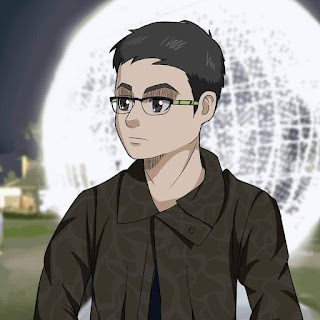
Driven towards lifelong learning and writing stories set both in alternate worlds and this one, Eriel Edward Red is currently pursuing a Master’s Degree in Creative Writing at the University of the Philippines Diliman. Prior to that, he graduated with a Bachelor of Arts in Theology, Major in Church Music Conducting at the Far Eastern Bible Institute and Seminary, pursuing both of his major artistic passions in the process. At the moment, he teaches music in the Philippine Missionary Institute, informing his students in matters of music, theology, and on occasion, stories that he made up and wrote. In addition, he has won several online writing competitions.
Outside of academia, he is an avid catlover, with three cats named Maria, Celestina, and Andronikos. He spends his free time thinking of new story concepts while taking long walks with the aforementioned cats, reading novels, watching science fiction media, and playing the piano.
Some of his other works include “Pictures”, a story of a day in the life of an immortal android serving the same family for centuries; “Drone Strike,” where a drone operator is forced to confront the consequences of his occupation; and “I Will Always Reach Out”, which shows what happens when an adoptive parent lives far longer than the adopted child.
Where did the story idea for “Room for One More” come from?
The first seeds of this story were planted when I read the speculative evolution book, All Tomorrows, by C.M. Kosemen. For those who aren’t in the know, All Tomorrows essentially traces a future evolutionary history of humanity over the next one billion years. I won’t spoil the contents, but suffice to say, the speculated forms of posthumans presented in the book piqued my interest in a different way. I thought, “What if someone has one of those weird, yet still human creatures as a roommate?”
With that said, I wrote notes and entries about my own posthumans, the Neosapiens, as they are referred to in this story, as well as the ‘lore bible’ I’ve written. I wrote them as a relatively marginal group, one that has immense difficulty fitting into baseline human society, whose infrastructure is not designed to accommodate them. As one may see in the story, some are more accepted; some are not so much; and some are just not thought about at all.
This story, narratively, speaks of understanding and cooperation with those who are very much not like us. It can be interpreted in a number of ways. Perhaps it could be about immigrants settling in with their “strange, alien ways.” Or about getting along with someone who is just weird, at least from your perspective. We cannot deny that at one point or another, there’s always that one person we know who finds it challenging to conform because they are different from the majority, from what is expected, or from what is accepted. It can be one of these, or all of them.
What came easy to you when it came to writing this story?
The setting was the easiest part, as the story, like many of the stories in my catalogue, are within a greater world that I’ve created and expanded over the years. This setting, Dreamspace, is written as an anthology about the lives of various individuals living in a universe where the Earth is destroyed, Mars is the center of human civilization, robots do most of the fighting, the government is filled with people who constantly operate under the influence of a drug that inhibits emotion, and several human populations have been genetically modified into various posthuman forms by an invading alien empire as a form of mockery. This story in particular focuses on that final aspect, with the premise that those posthumans are being integrated into a “polite society,” one that has never been “affected” by armed conflict. That polite, insulated society has always been a foundational part of the world, echoing real-life perceptions of something like an American suburb or a condo complex here in Metro Manila, whose people have never seen the ‘unstable outside,’ especially conflict hotspots like the Middle East, the Sahel, and Central Asia, other than in the news or from a comfortable distance. These are distant events, for the most part; things that are just not worth spending time worrying about when it’s already taken care of by someone else, or it is just “someone else’s problem.”
What was the most challenging thing you had to overcome to complete this story, and how did you deal with that?
The difficulty when it comes to having a pre-established universe for most of my stories is that every time I write, I have to resist the urge to make excessive expositions of the surroundings and the lore on them. Furthermore, I tend to think, “What if they don’t understand this particular thing?” And then, I’ll fly off into an explanation, which has the danger of getting longer than the actual dialogue and story. One might say that I often don’t trust readers enough to draw their own conclusions from relatively scant details.
Suffice to say, this story took more than a month to complete, mostly because after I finished the initial draft, I would look back at it and check if it worked just right. It became long, was shortened, was lengthened again, and became of a medium length. I suppose the determining factor of when and how it was ‘just right’ is a simple instinct that I get while rereading.
What are the top three writing tips you would like to share with all aspiring storytellers out there?
The first tip I would give, when it comes to stories in speculative fiction that are meant to be in a larger universe, is to make the world feel like a big place; when a particular story is read, it feels like it is part of something bigger. You don’t have to be explicit with statements like “an empire of a million words” or “this is a town in Ancapistan, which is a large place.” Hell, I would recommend not actually saying that. I do this mostly with implications and references. In Room For One More, one way I tell of a larger universe that potential readers might want to look further into by reading my other stories is by the characters talking about things that, to them, are everyday facts or just a bit of the news, but is… news to someone reading for the first time. They talk about the places they’re from when it’s appropriate, where they are, and where they went to. This, I feel, is a natural way to imply that there is a bigger world out there.
A second tip in storytelling is…food. Yes, you read that right. Food, in my opinion, is an underrated part of story-writing and worldbuilding. One of the most natural forms of interaction any group of characters can have is sitting down to eat—it’s a good way to tell the readers about the world without it feeling like an enormous lore dump. A meal in real life is often where people talk about, well, anything. Anyone can certainly relate to lunch being where political alignments are discovered and arguments occur. Furthermore, the kind of food present in a story tells much about the people in it. The way they prepare it (someone who just heats frozen food is either lazy, busy, or unmotivated) and what it is (having plenty of meat implies economic prosperity or even post-scarcity, as an example, or a particular character’s religion may encourage or prohibit certain foods). One might even say that it is a worldbuilding and storytelling panacea. I could explain more, but I feel that it would be better (and easier) to tell you that there is a video on YouTube by Hello Future Me that explains just that, entitled Food Is A Worldbuilding Superpower. Just keep in mind: food is important, both in real life and in fictional stories.
A third tip I’d like to give is don’t be afraid of things that sound crazy at first. This story’s premise can be summed up as “local man is forced to have a giant centipede-like posthuman as a roommate.” It’s an absurd premise when looking at it for the first time; at least, I think it is. Ultimately, this is more of a subjective tip that may or may not be of benefit to you, as it’s something that depends on what you, a prospective storyteller, wants to do. If you want something grounded, then sure, be grounded, be realistic. In speculative fiction, though, I have a preference for those that go all in, so to speak, fully embracing the premises they have. It’s speculative, after all; it doesn’t have to be congruent with reality.
What’s the one thing not mentioned in your profile that you would like people to know about you?
Everyone should know that I hope that the AI Bubble pops hard.
Look it up if you don’t know what that is. Just do it.