
by Christine V. Lao
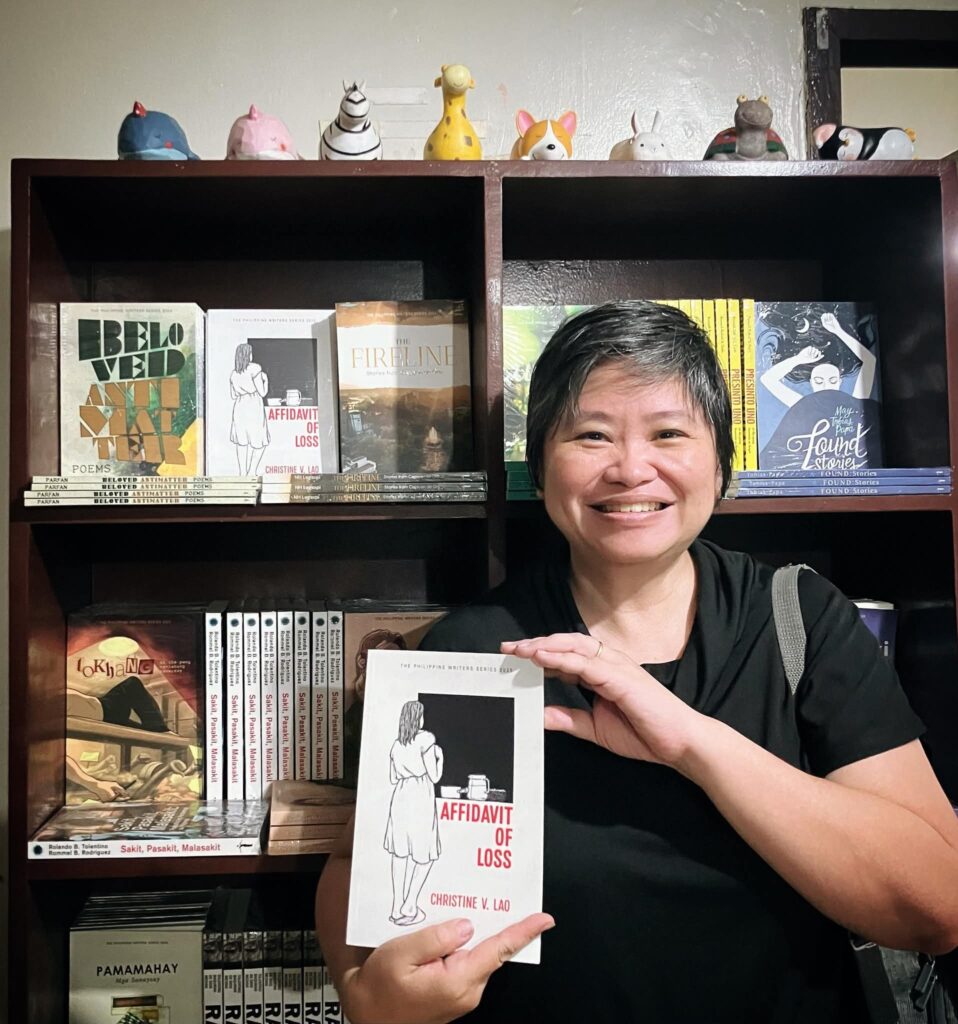
Christine V. Lao with her book, “Affidavit of Loss”
In the Philippines, as elsewhere, genre fiction has long had to prove its worth. Often overlooked by academic and literary spaces and dismissed as less serious than realist writing, these stories have thrived in communities—online forums, book and fan clubs, and popular magazines—where writers create for the love of imagining, and readers seek worlds that challenge, delight, or surprise.
Genre fiction allows writers to grapple with contemporary issues through imaginative frames: futures shaped by technology, mythic retellings of folklore, uncanny explorations of criminal or political violence, or body horror that magnifies social anxieties. These genres often move through inventive narrative strategies—shifts in perspective, immersive world-building, and formal experimentation—that engage readers while reflecting historical, social, and technological pressures.
Lately, the tide seems to be turning, with academic and literary spaces beginning to pay attention. Recent anthologies that highlight contemporary Philippine fiction such as Sigwa: Climate Fiction Anthology from the Philippines (Polytechnic University of the Philippines Press, 2019); Bravura: An Anthology of 21st Century Philippine Fiction (University of the Philippines, 2020); and Kritika Kultura No. 48 (Ateneo de Manila University, 2025) include among their pages works of sci-fi, fantasy, and horror. In 2024, the University of the Philippines Press published Mapping New Stars: A Sourcebook of Philippine Speculative Fiction which takes an academic look at the work genre writers have been producing in the Philippines.
At a forum on genre fiction organized by Philippine Genre Stories in partnership with Likhaan-Institute of Creative Writing in October 2025, it was observed that many of the resource persons drawn from reader communities were themselves published authors who had attended university workshops or had works released by university presses. They blur the line between the communities they represent and the institutions that recognize their work, showing that the divide between grassroots support and formal acknowledgment is not absolute, and is in fact more porous than is often assumed.
My curiosity about this connection between community and formal, academic recognition shapes the selections that will be featured on Philippine Genre Stories (PGS) for the next six months. From February to July 2026, PGS will present six genre stories by student writers and popular authors deeply engaged in organizing and maintaining reader/writer communities outside academia. Instead of demanding each story to conform to a single aesthetic or political program, I read them to find the ideas they engage with, and how their engagement with genre becomes a way to explore these ideas; to identify the pressures of daily Philippine life that they respond to in ways meaningful to readers like me, as well as readers who aren’t like me. To my mind, this approach aligns with how creative writing is enjoyed by reading communities both within and outside the classroom: it acknowledges the diversity and intellectual depth of Philippine genre writing while staying attentive to what makes these stories valuable within and beyond their respective circles.
It is an approach that is inherently political, challenging, as it does, hierarchies of literary value that have often sidelined genre writing and community-based forms of production. It insists that political meaning does not only reside in realist representation or in didactic critique. No single mode of writing, reading, or thinking can account for the complexity of contemporary Philippine experience. At a time when global fascism, late stage capitalism, and the ubiquity of AI all threaten to flatten many ways of being and thinking into the same, affirming this plurality is, arguably, a deeply political stance.
Pingback: Reflection 4 – Colonialism, Language, and Power – My Lib Lab